

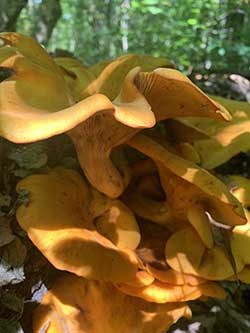
From the time the first plants established themselves on land, plants have relied on fungal partners for their survival. Today all plants interact with fungi in some way, ranging from beneficial symbionts vital for plant growth to deadly pathogens that can wipe out whole fields. Forests, in particular, rely on diverse fungal communities to cycle nutrients, promote tree growth and stress tolerance, and maintain diverse tree mixtures. In this presentation, I will discuss what is currently known about the roles fungi play in healthy forests and highlight where the biggest scientific gaps and controversies still exist. Then, I will describe some of our current research investigating how fungal communities are distributed across the forests of the eastern US, how fungi may be promoting resilience of trees in the face of changing climates, and finally, how we can use our knowledge of fungal interactions to enhance restoration of forests.

Richard Lankau is a professor of Plant Pathology at the University of Wisconsin, Madison. His research interests focus on how plants interact with diverse communities of microorganisms in and around their roots, and how these interactions affect plant tolerance to stressors like droughts, heat, or disease. His research group works primarily in temperate forests as well as a variety of agroecosystems in the Midwest USA. His research group seeks to leverage our understanding these interactions at the smallest scale to help solve challenges at the global scale, including adaptation to changing climates, conservation of biodiversity, and maintaining food security for a growing population.