Birders: The Central Park Effect, Review by Helen Hays
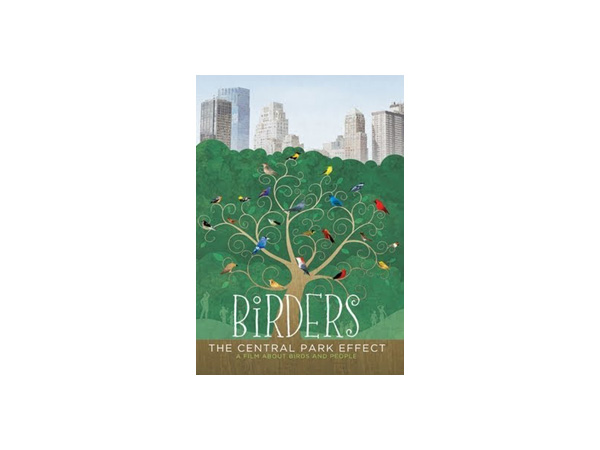
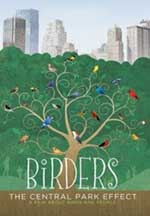
Birders: The Central Park Effect
A Film by Jeffrey Kimball
Music Box Films, 2012

On occasion an individual has a vision coupled with the ability and drive to translate their vision into something we can all feel and understand. Jeffrey Kimball, Society member and former Council member, has done this in his excellent film Birders: The Central Park Effect. Jeff shot, wrote the narration, produced, and directed the film, scheduled to be shown at the Society’s meeting on January 8, 2013. Daniel Baer edited the film. Jeff’s wife, Pamela Hogan, and Tom Casciato are the executive producers. Since starting the film five years ago, Jeff has been totally committed to it. Working about half of each year on the film for the first four years, he took out a bank loan in the fifth year so he could work full time on the film and finish it.

In his film Jeff highlights the green habitat that is Central Park in the midst of Manhattan’s concrete pavements and buildings. It is an area for recreation for New Yorkers, as well as a valuable habitat for migrant and resident birds. Jeff concentrates on the birds and birders in Central Park. His camera work is excellent. His narration and dialogue lead the viewer though the park in different seasons of the year, underlining through remarks by the people birding in the park, what a wonderful habitat it is for birds and birders.
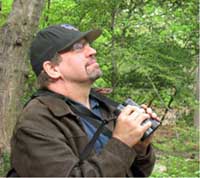
Jeffrey Kimball © 2012 Joe DiCostanzo

Jeff was born in San Francisco and grew up in the Bay area. In high school he played drums in a band, but said he didn’t have a sense of rhythm. He also tried acting, but felt self-conscious in front of a camera. He went to Stanford for his undergraduate work. The summer between high school and college was a turning point for him. He became aware that what he really wanted to do was go into film. That summer he discovered three films, among the many he watched, that he found fascinating: A Clockwork OrangeCasablanca, and Chinatown. He found a different thing interesting in each. In A Clockwork Orange he admired how the music and visuals were used to create a technical tour de force. Casablanca had a compelling story and in Chinatown the camera work and music were skillfully combined to create a mood. That fall he entered college and took a course in film aesthetics. Later his first film production course was in the making of documentaries.

At twenty-five Jeff came to New York to enter New York University for his Master of Fine Arts in film. He met his wife, Pamela Hogan, who makes documentaries, in the larger film community of New York City. While living and working in New York, Jeff still does a lot of work in California, returning to San Francisco several times a year. When he began working he worked in editing rooms for a variety of types of films before doing music for feature films. He organized the music for among others, Good Will HuntingA Bronx TaleFlirting with Disaster, and Swingers.

While in New York Jeff signed up for Joe DiCostanzo’s American Museum of Natural History bird walks in Central Park. He was delighted at the number of birds it was possible to see there every day. During the winter after he joined Joe’s walks, Chuck McAlexander called him and asked him if he wanted to go birding in the park in January. Jeff must have hesitated, because Chuck assured him you could see birds in Central Park in the winter. They saw twenty-six species that day. Again, Jeff was impressed and excited that here was a place in the middle of New York City where you could see birds any day of the year and both his wife and Tom Casciato told him he had reached a stage where he was in a position to make a movie on the birds of Central Park. And so it began…

Jeff knew he wanted to film many birds for his production, and thought he might have to film birds in other places, and then include them by noting that they were also found in Central Park. As he worked he found there was no need to film elsewhere and he took many beautiful shots of birds, all in Central Park. After two years he had enough footage of birds for the film and began filming people birding in Central Park. There were definitely talking points he hoped to bring out in interviewing birders in the park and wrote out questions before he met people to walk and talk in the park. Sometimes he was surprised by the answers he elicited. When I saw the film I was impressed by how articulate the people involved were, which, in part, is a tribute to Jeff’s skilled questioning in combination with excellent editing by Daniel Baer. Jeff said often the characters in the film came together in the editing room. All the people in the film sound natural and seem to be enjoying themselves.

In the first version of the film there was no narration. Those who attended a screening in 2011 thought narration would help to move visuals along, as for example, to make changes in seasons clear. Jeff world premiered his film at the South by Southwest Festival in Austin Texas in mid-March of 2012. HBO picked up the domestic TV rights to his film for a year. HBO will be premiering the film on July 16, 2012 at 9:00 pm. It will then be available on HBO On Demand. They have exclusive rights for six months and after that it can be shown on iTunes or available on DVD. A number of other groups have expressed an interest in Birder’s: The Central Park Effect, so stay tuned.

Jeff fits birding in when traveling with his family by birding early and returning in time to have breakfast with everyone. When his sixteen year old son, Ryder, saw Birder’s: The Central Park Effect, he said: “I get it, I get why you do it.” which pleased Jeff because he is concerned people understand the importance of parcels of land like Central Park and the value to humans and to wildlife in saving them. Jeff’s stepson, Aaron Profumo, will enter the Yale Drama School this fall, an exciting step for the whole family. Who knows, in the future Jeff and his stepson may meet on a set on opposite sides of the camera!

When Jeff finished Birders: The Central Park Effect he treated himself to a trip to Texas where he saw seventeen life birds.

As noted above, Geoffrey Nulle has scheduled a showing of Birders: The Central Park Effect for the Linnaean meeting on January 8, 2013. It is a documentary that has never been done before; a film you shouldn’t miss. Bring your friends. If they are not birders they will see an aspect of the park new to them. If they are birders they will appreciate Jeff’s focus on the park as a wonderful place for birds and birders, something to be valued and protected!
Histories of Ornithology, Reviews by Joseph DiCostanzo

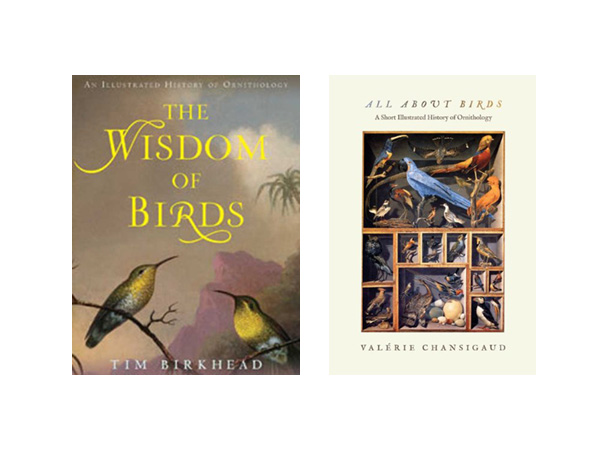
The Wisdom of Birds: An Illustrated History of Ornithology
Tim Birkhead
Bloomsbury USA, 2008

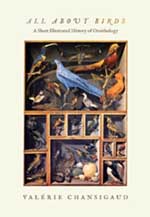
All About Birds: A Short Illustrated History of Ornithology
Valérie Chansigaud
Princeton University Press, 2010

These interesting and attractive books are devoted to the history of the study of birds. The classic work by Stresemann (1975), a scholarly history aimed at a professional audience, has long been out of print. Also, as an English translation of a German book originally published in 1951 it is now six decades old. There have been more recent works, generally of a more specialized nature: Farber (1982) looks at ornithology’s development as a modern science from the late-18th Century to the mid-19th Century while Walters (2003), though aimed at a more general audience than the earlier works, emphasizes classification and taxonomy. Despite its title, Bircham’s (2007) book focuses on the history of British ornithology rather than the field as a whole. For American ornithology see the fine book by Barrow (1998).

Stresemann’s study contains no illustrations (other than a frontispiece photo of the author) while Walters’ has many pictures of scientists and a handful of birds (all in black and white). These latest two boos by Birkhead and Chansigaud, as did the works mentioned above, originated in Europe, but as their subtitles state are heavily illustrated. Beyond that these two new works take very different approaches to their subject.

Chansigaud’s book was originally published in France in 2007, with an English translation in the United Kingdom in 2009 and finally this American edition. It is a relatively slender volume and follows what might be considered a more traditional approach than Birkhead. After a brief introduction, seven chapters chronologically look at ornithology, starting with “Antiquity” followed by “The Middle Ages” and “The Renaissance”, then a chapter each for four centuries from the 17th Century to the 20th Century. From Aristotle to 20th Century ornithologists, the focus is the people who have brought the study of birds from mythology to a modern science. The text is clear and well-written; however the occasional odd phrasing reminds the reader that it was not originally written in English.

The main illustrations are nearly all of birds from illustrated works over the centuries. Except for older monotone works these are all in color. The quality of the reproductions is excellent, if a bit small. Many famous bird artists are represented including Audubon, Fuertes, Gould, Keulemans, Lear, Wilson and others; some of these are themselves discussed in the main text. There is also some lovely work by unknown Indian artists (pp. 111, 115), a legacy of the British Empire. Unfortunately, there are also a few illustrations where the artist is not credited and only the author of the work in which it was published is listed (such as pp. 150, 157, 160). For a dedicated survey of bird art, see the beautiful book by Linnaean members Pasquier and Farrand (1991) or the more recent one by Elphick (2005). Throughout Chansigaud’s book there are smaller, marginal illustrations. A few are the title pages of major publications or the logos of important organizations, but most are pictures of the people discussed in the main text. The captions of the latter usually include information about the person. I noticed one misleading caption. Under the photo of Ernst Mayr (p. 202), one of the 20th Century’s top ornithologists and a long-time Society member, it states he made his career at the American Museum of Natural History. While Mayr first came to the United States to work in New York (1931-1953) and did much important work at the American Museum, he spent most of his long life and career at Harvard’s Museum of Comparative Zoology (1953-2005).

Chansigaud’s book concludes with a few pages on the current role of ornithology and ornithological collections, a brief bibliography, an index of people and institutions and a twenty page timeline from 340 BC to 2002.

Instead of strict chronological order, Birkhead’s organizes his book around the biology of birds. In chapters devoted to different aspects of avian life history he traces the historical discovery and development of knowledge in each subject. There are chapters on embryology, development and instinct, migration, breeding cycles, territory, song, sexual dimorphism, mating systems, longevity and lifetime reproduction. Throughout, material is presented in a well-written, clear, nontechnical style accessible to a general audience. The reader will learn a lot of history, as well as avian biology. One fascinating story concerns the Acorn Woodpecker. Acorn’s are social breeders living in groups – young males from previous seasons assist their parents while females disperse to other groups. Birkhead tells the story of a researcher following a young female as she moved to another group only to be driven off by that group’s males. The female returned to her family and after interactions with her brothers went back to the second group accompanied by her brothers who attacked the males there until she was accepted! Her brothers then returned to their own family group.

As in the previously discussed book, this book is extensively illustrated in color, mostly with plates from old bird books, but here the plates are chosen to illustrate a biological subject being presented, rather than primarily as examples of bird artists. There is an extensive bibliography, a short glossary and a full index.

The central figure in Birkhead’s history, the man he considers “the most influential ornithologist of all time” is 17th Century polymath, cleric and naturalist John Ray (16271705). A recent book on history’s greatest naturalists refers to Ray as the “English Aristotle” (Huxley 2007 – a book I also recommend). The encyclopedia Ornithologia Libre Tres by Francis Willughby, published by Ray in 1676, is often considered the birth of ornithology. (In Chansigaud’s book the subtitle of his 17th Century chapter is “The founding work of John Ray and Francis Willughby”.) Ray was the son of a blacksmith. Willughby, Rays’ junior by eight years, came from the aristocracy. They met as students at Cambridge and in spite their different backgrounds became best friends and coworkers. When Willughby died in 1672 at age 37, Ray became one of his executors and tutor to his children. Until then primarily a botanist, Ray completed the bird book they had been working on, publishing it under his friend’s name. Ornithologia presented the first modern classification of birds, often considered superior to the one proposed by Linnaeus sixty years later (Stresemann 1975). For over 300 years debate has continued, heatedly at times (Raven 1942, Bircham 2007), on who should receive the majority of the credit. One of Ray’s later books, The Wisdom of God Manifested in the Works of the Creation (1691) inspired the title of Birkhead’s book. Following Haffer (2007), Birkhead presents the case that after Ray ornithology followed two parallel, but separate paths. One, with roots in Ornithologia, stressed classification and faunal studies, while the other, stemming from The Wisdom of God, stressed field study. The two branches were reunited into modern avian biology in the 1920’s and 1930’s by Erwin Stresemann and David Lack. In a way Chansigaud’s and Birkhead’s two histories reflect that dichotomy and complement each other very well.

Though the Linnaean Society of New York is not mentioned in either book, papers published in Society publications are mentioned, sometimes prominently. Birkhead’s bibliography includes papers by Ernst Mayr, Margaret Morse Nice and Nikko Tinbergen originally published in the Society’s Proceedings and Transactions. Chansigaud also mentions Nice’s landmark Song Sparrow work and Tinbergen’s Snow Bunting study.

Literature Cited

Barrow, M. V., Jr. 1998. A Passion for Birds: American Ornithology after Audubon. Princeton Univ. Press.

Bircham, P. 2007. History of Ornithology.

Collins. Elphick, J. 2005. Birds: The Art of Ornithology. Rizzoli.

Farber, P. L. 1982. Discovering Birds: The Emergence of Ornithology as a Scientific Discipline, 1760-1850. Johns Hopkins Univ. Press.

Haffer, J. 2007. The Development of Ornithology in Central Europe. Jour. of Ornithology 148 (S125-S153).

Huxley, R. (ed.) 2007. The Great Naturalists. Thames and Hudson.

Pasquier, R. F., and J. Farrand, Jr. 1991. Masterpieces of Bird Art: 700 Years of Ornithological Illustration. Abbeville Press.

Raven, C. 1942. John Ray, Naturalist: His Life and Works. Cambridge Univ. Press.

Stresemann, E. 1975. Ornithology from Aristotle to the Present. Harvard Univ. Press.

Walters, M. 2003. A Concise History of Ornithology. Yale Univ. Press.

A New Dictionary of Birds, Review by John Bull

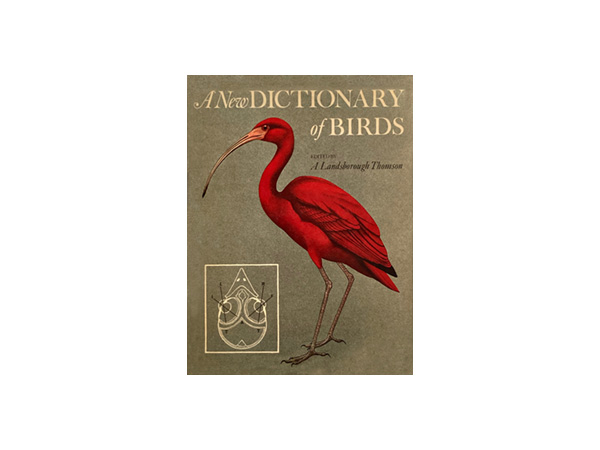
A New Dictionary of Birds
Edited by Sir A. Landsborough Thomson
McGraw-Hill, 1964

Although a dictionary in name, this stupendous volume is encyclopedic in scope. Numerous cross-references make this notable book of the utmost value. The many collaborators are specialists in their own fields and come from all corners of the globe. Most are renowned ornithologists having broad attainments and interests in scientific matters.

Articles of great interest both to the layman and scientist cover such diverse subjects as zoogeographic regions, ethology (behavior), classification, taxonomy, nomenclature, climatology, coloration, structure, disease, domestication, ecology, toxic chemicals (pesticides), adaptive radiation, eggs, parasites, evolution, molt, extinction, fossils, conservation, flight, genetics, imprinting (learning), migration, musculature, nests, speciation, numbers (density), plumage, ringing (banding), vocalization, anatomy, statistics, territory, mimicry, and numerous others. The treatment and discussion of the bird “groups” is made generally at the family or subfamily level.

Of great interest to students of distribution and evolution are the excellent articles on the zoogeographic regions: the Australasian by Serventy; the Oriental by Salim Ali; the Ethiopian by Moreau; the Palaearctic by Voous; and both the Nearctic and Neotropical by Mayr.

To the reviewer, one of the most fascinating articles is that on extinction by James Fisher, excellently summarized with tables.

The illustrative material varies in quality, but the many black and white photographs are superb. By and large the color paintings are attractive, those by Talbot-Kelly and Reid-Henry especially so. The illustration of the Screech Owl, however, done by another artist is barely, if at all, recognizable. A few errors inevitably crept in: on page 315 the figure labeled an Eastern Kingbird should be Scissor-tailed Flycatcher; on plate 8, the Rock Ptarmigan, figs. 3 and 4 are transposed— they should be “summer” and “winter” respectively; on plate 12 the corvid perched on a fish is appropriately enough, a Fish Crow, not a Common Crow (see Cruickshank, Birds around New York City, 1942, p. 319).

Landsborough Thomson is to be congratulated on organizing and editing this superlative volume, as well as contributing a number of major articles, altogether no small undertaking. The serious naturalist and birdwatcher will want to add this book to his library—a purchase well worthwhile.